


Hi Friends,
Welcome to the 161st issue of the Polymethic Engineer newsletter.
Regardless of whether you are an experienced software engineer or are earlier in your career, performance reviews can be scary. There are so many ways they cause anxiety: you get graded as an employee, often compared directly to your peers, and in some big tech companies, the bottom 5-10% get cut every cycle.
But here’s the thing: performance reviews are a system. And like any system, once you understand how it works, you can learn to navigate it effectively.
Many engineers treat performance reviews as something that happens to them. They put in the hours, work hard, avoid negative feedback, and hope for the best. However, this is a dangerous mentality. It can work sometimes, but the more important thing to think about is when it doesn’t. And you want to minimize that as much as possible.
The engineers who consistently get strong ratings and promotions aren’t just better at coding. They understand how the game is played. They know how they are measured, they prepare strategically, and they make sure their work is visible to the right people.
In this issue, we break down the recipe for succeeding within a performance review:
Understanding the Yardstick
The three types of performance review systems
Preparing for success before the cycle begins
Executing during the cycle
Writing feedback that matters (for yourself and others)
Project-based learning is the best way to develop technical skills. CodeCrafters is an excellent platform for tackling exciting projects, such as building your own Redis, Kafka, a DNS server, SQLite, or Git from scratch. Sign up, and become a better software engineer.
Understanding the Yardstick
The output of a performance review system is typically a rating. Think of it like school grades: you need to understand what the meaning of each rating is, what is considered average, and what you need to do to get promoted.
For example, at Meta, the rating system looks like this:
Meets Some: You are doing quite poorly. Getting this rating usually means you will be put on a PIP or even fired.
Meets Most: You are not meeting all expectations. Two or more Meets Most ratings typically lead to a PIP.
Meets All: The default rating. If you just joined the company or are doing solid but unremarkable work, this is where you land.
Greatly Exceeds: One level up from Meets All. This is quite hard to achieve.
Redefines: The top rating, significantly harder than Greatly Exceeds.
Most other companies have a similar system. However, there is a part that surprises many engineers: the distribution of ratings is uneven. The bottom two ratings usually apply to 5-10% of employees. Around 40% get the middle rating, another 40% get the first “exceeds” tier, and only 10-15% reach the top rating.
This distribution also changes as you become more senior. At the junior level, it is common for most engineers to receive an “exceeds” rating because expectations are lower. But at senior levels, getting that same rating becomes much harder, and 60-70% of engineers end up with the equivalent of “Meets All.”
And here is the counterintuitive part: a Meets All rating does not mean you are doing well. It means you are effectively in the bottom half of your level. If you are aiming for promotion, Meets Al is not enough. In fact, it is almost a bad signal because it means you're not standing out from your peers.
So the first step is to understand your company’s rating system and ask yourself: What are the expectations for my level? Which rating is considered average? What is needed for promotion? The answers will be different for each company and each level.
The Three Types of Performance Review Systems
There are different kinds of performance review systems. Companies usually fit into one of three groups based on how they gather feedback and the power their managers have.
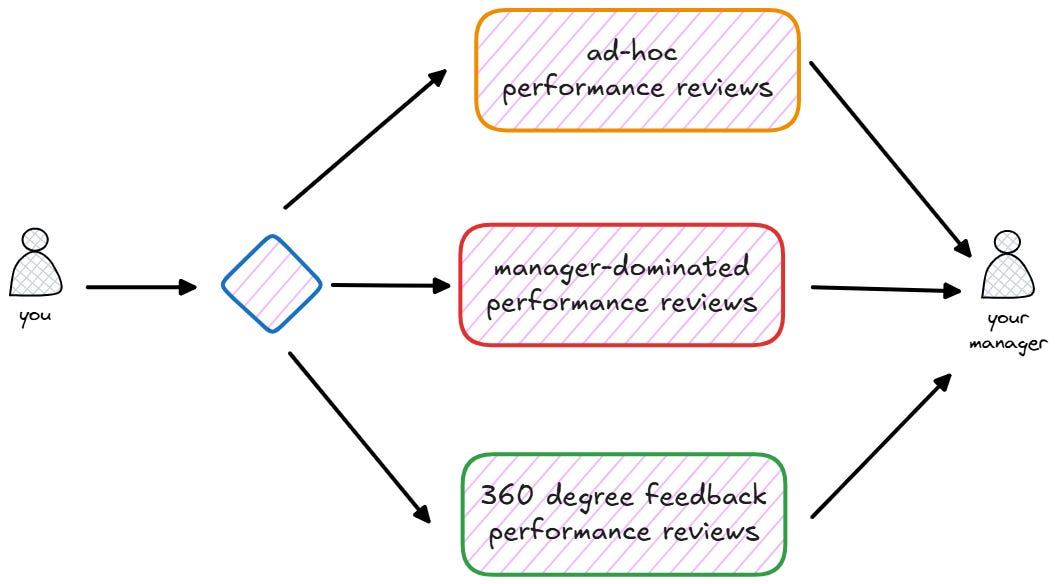
The ad hoc systems are the worst type. There is no regular framework, and feedback only happens when something major occurs. Maybe you made a significant mistake, or you told your boss you have a competing offer. Suddenly, they scramble to tell you how valuable you are and offer you a raise to stay.
This approach is common at small startups and consulting shops. The problem is that it rewards the squeaky wheel. Engineers who know how to complain and play politics make more money than those who just do their jobs.
In manager-dominated systems, performance assessments are conducted regularly, but your manager has full authority over your rating, compensation, and promotion. This is common in older companies, especially those where software engineers work in the IT department.
The problem here is that your career is based on what one individual thinks. You do well if your boss likes you. If they don't, or if they just don't speak out for you, your growth will stop, no matter how amazing your job is.
The 360-degree feedback system is what modern tech companies use. The idea is that feedback comes from all directions:
From within: you write a self-review
From above: your manager writes feedback about you
From the side: peers you have worked with share their perspective
From below: if you lead a team, your reports evaluate your leadership
The benefit of this approach is that it provides the clearest picture of how well you are doing. It also prevents one individual from having too much control over your career. Strong peer feedback might make up for your manager not valuing you enough. If you say you are a great team player, but your partners from other departments don't agree, that will show up too.
If your company does not have a 360-degree feedback system, think about introducing it yourself. You can ask your coworkers for feedback regularly via email or Slack. Ask them how you could improve on certain projects. If you can create a culture of organic feedback requests, that is a powerful thing for both you and your team.
Why Promotions Should Be Lagging
It took me a while to get this concept, but it changed how I think about career growth.